
Padel Court
Padel Court


UNISPORT Padel Court Factory - Where Innovation Meets Craftsmanship
UNISPORT is more than a padel court manufacturer — we are the backbone of the UNIPADEL brand, dedicated to advancing padel sports worldwide through high-quality products and reliable end-to-end solutions.
• Innovative Technology
Our in-house R&D team refines every component of our padel courts. From high-tensile steel frames and impact-resistant glass panels to UV-stabilized artificial turf, we test every material and production process to meet and exceed international standards for safety, durability, and consistent playability.
• Custom Solutions
Every padel project is unique, and we design our courts to match. Whether you need standard double courts, compact single layouts for urban spaces, or custom branding and color schemes for commercial venues, we adapt dimensions, materials, and finishes to fit your site, budget, and local requirements.
• Sustainability
As a responsible manufacturer, we integrate sustainability into every step of our production. We use environmentally friendly materials and production processes. Our long-lasting courts reduce replacement needs, supporting both your bottom line and the environment.
• Global Reach
With a presence in over 50 countries, we work closely with distributors, sports operators, and investors worldwide, providing region-compliant designs, clear documentation, and reliable logistics support to ensure seamless delivery and installation, no matter where your project is located.
At UNISPORT padel court factory, we don’t just build padel courts — we build partnerships that drive the growth of padel sports globally. Let’s explore how we can bring your vision to life.
Padel Court - Leading Manufacturer in China Since 2018
As China’s leading padel court supplier by total export sales since 2018, we specialize in the R&D, manufacturing and delivery of high-quality padel court systems for global clients.
Padel tennis has become one of the most popular sports worldwide in recent years, favored by investors for its accessibility, low entry cost and strong appeal to players. Our fully enclosed padel courts support both single and double court layouts, ideal for installation in clubs, commercial spaces and sports facilities to drive foot traffic and maximize usage.
Our padel courts have been exported to more than 50 countries, delivering reliable, durable and customized solutions to meet diverse project requirements.
Why Choose UNISPORT Padel Court?
As a professional padel court manufacturer and factory based in South China, UNISPORT delivers FIP-certified, high-performance padel courts trusted by clubs, resorts, investors and sports facilities across 50+ countries. We control the entire production chain—from raw material sourcing to final assembly—ensuring consistent quality, shorter lead times and factory-direct pricing. Our core advantages include:
• Full FIP and CE Compliance
All courts meet International Padel Federation (FIP) standards and European CE safety certifications, suitable for professional tournaments and commercial use.
• Premium Materials
12mm tempered safety glass, hot-dip galvanized steel structure, anti-UV synthetic turf with silica sand infill, and LED lighting systems.
• 15+ Year Lifespan
Corrosion-resistant, wind-resistant, earthquake-resistant and low-maintenance design for all climates.
• Modular and Fast Installation
Pre-assembled components reduce on-site setup to 5–7 days per court; our global installation teams support on-site assembly and local worker training.
• Complete Customization
Custom RAL colors, club branding on turf/glass, panoramic/super panoramic/indoor/roofed configurations.
• Turnkey Solution
One-stop service including design, production, shipping, customs clearance, installation and after-sales support.
• 10-Year Warranty
Full structural warranty and lifetime technical support for every padel court.
UNISPORT CE-Certificated Padel Court
UNISPORT padel court systems are manufactured with key components supported by CE certificated, helping project buyers meet European procurement, safety and quality requirements.
Our documented components include galvanized steel mesh and galvanized steel structures, artificial grass and 12 mm tempered safety glass. The applicable standards include EN 10223-1, EN 10223-4, EN 15330-1 and EN 12150-2.
• Galvanized Steel Mesh: Documented to EN 10223-1 and EN 10223-4
• Artificial Grass: UNI-Padel turf documented to EN 15330-1
• Tempered Safety Glass: 12 mm glass verified by SGS to EN 12150-2 for CE marking
• Galvanized Steel Structure: Conformity documentation available for selected UNI-PD01, UNI-PD02 and UNI-PD03 models
From structural components and safety glass to the playing surface, UNISPORT helps buyers build padel court projects with clearer specifications, traceable documentation and reliable quality control.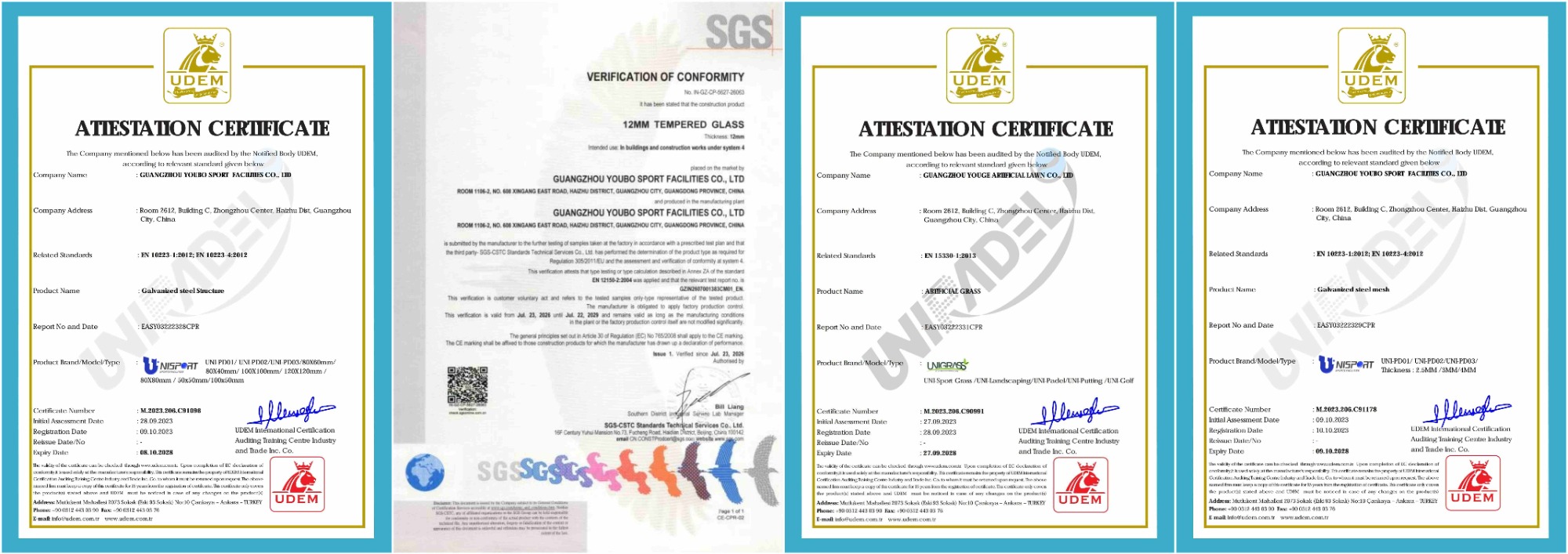
What types of padel tennis courts are there?
Our GZUNISPORT specialize in helping customers customize and install padel courts. We already have a very mature system in the industry. It is our min imum target that the color will not fade for 5 years and the paint will not fade for 10 years. Generally, we help clients provide the following popular padel venues.
Super Panoramic International Competition Standard
(1) No pillars at the four corners
(2) Intuitively see the entire stadium
(3) Suitable for professional competitions
(1) Similar to 360° panoramic view
(2) There are pillars at the four corners
(3) The most purchased style
(1) It uses the most pillars
(2) The stability is also very good
(3) The cost is relatively high
Is padel popular in Asia?
Padel, a racquet sport similar to tennis and squash, has been steadily growing in popularity worldwide, including in Asia. While it may not be as widely popular as in some other regions, such as Europe and Latin America, there has been an increasing interest and adoption of padel in various Asian countries.
Padel has gained some traction in countries like India, China, Japan, South Korea, and the United Arab Emirates, among others.In India, for example, padel has been gaining popularity, and there are several padel courts and clubs in cities like Mumbai, Delhi, and Bangalore. China has also seen a growth in padel, with courts being built in major cities like Beijing, Shanghai, and Guangzhou. In Japan, the sport has been gradually gaining attention, and there are a few clubs and facilities offering padel.
Can you convert a tennis court into a padel court?
In the ory it is possible. It mainly depends on whether the customer has high requirements for the court. The entire project is based on pouring strips. For example, cement floor, asphalt or acrylic floor can be used to play padel. If you need to add artificial turf, these can be customized.
In fact, padel is already a very popular sport in many parts of Europe. Normally, the tennis courts we see are relatively large, but padel is only about 1/3 of its size, and the operation is relatively simple. Professional padel rackets are relatively small, with a general length of 45-50cm. The ball used is also similar to tennis balls, and the weight is also similar. The pressure difference of a padel ball is about 10psi, which is indeed smaller than that of a tennis ball.
The padel court internal playing area is 20m x 10m wide and is marked with twoservice lines and a centre line that crosses over the service line by 10cm. Padel generally implements doubles (of course, our manufacturer also provides singles venues). The overall gameplay is similar to tennis, because padel is relatively closed, the ball can bounce off the wall, and the serve must be below the waist.
The ball must be hit After hitting the floor, hit the ball again. After the opponent serves the ball, you can directly buckle it in the form of badminton, or you can hit the ball after hitting the floor, or you can hit it after bouncing off the glass. All in all, padel is suitable for men, women, children, and couples. Customers who have customized with us recently gave us feedback, and they all think it is very good, which also proves that investors have a unique vision
Padel Court Production
Every UNISPORT padel court undergoes 8 strict production and QC stages:
Material Inspection: Raw steel, glass, turf and accessories tested for certification and durability.
CNC Cutting & Fabrication: Automated cutting ensures ±0.1mm precision for all steel components.
Welding & Polishing: Full automatic welding for structural stability; polished to avoid burrs.
Hot-Dip Galvanizing: Double-layer zinc coating for maximum anti-corrosion.
Powder Coating: Custom RAL colors with UV-resistant powder; 200°C baking for strong adhesion.
Glass Processing: Cutting, edging, tempering, safety testing and printing (branding).
Assembly & Pre-Testing: Full court pre-assembly in factory; check flatness, stability and safety.
Packing & Shipping: Protective packaging; container loading optimization to reduce shipping damage.
Factory Capacity: Annual production capacity of 2,000+ padel courts; average lead time 15–20 days for bulk orders.
FAQ
1. What is the difference between a padel court and a tennis court?
Padel courts are smaller (20×10m vs 23.77×8.23m), enclosed with glass/mesh walls, and played in doubles. Walls are part of gameplay, making rallies longer and more dynamic.
2. Are UNISPORT padel courts CE certified?
Yes, comprehensively. Galvanized steel structure and mesh are CE-certified to EN 10223-1/4 by UDEM; 12mm tempered glass to EN 12150-2 by SGS; artificial turf to EN 15330-1:2013 by UDEM. All certificates are available for review and our courts fully comply with EU market access.
3. Do you provide installation service?
Yes. We send professional teams worldwide or train your local workers.
4. What is the minimum order quantity?
No MOQ. 1 court for trial; bulk orders (10+) get factory discounts.
5. Are your courts FIP certified?
Yes. All our courts meet FIP international standards and CE certification.
6. What type of flooring is on a padel court?
CE-certified artificial turf with silica sand infill. Standard area 10m×20m. Can be laid over concrete, cement or asphalt; custom colors available.
7. Why do some padel courts have sand?
Quartz sand prevents slipping, cushions players' knees, and stabilizes turf fibers. Combined with adhesive, it creates a secure, long-lasting surface.

