Product Overview
|
Design wind speed |
220 km/h (136.8 mph) |
|
Hurricane design standard |
Category 4 |
|
Main upright |
200 × 200 × 6 mm square steel section |
|
Containment mesh |
50 × 50 × 4 mm welded steel |
|
Playing area |
20 × 10 m |
|
Glazing |
12 mm thermally toughened safety glass |
|
Protection |
Hot-dip galvanised inside and out + anti-UV polyester powder coat |
|
Compliance |
FIP court standard; CE-standard bolts and glass clamps |
INTRODUCTION
For protected locations, a padel court is all about playing experience. For open, windy sites, it must survive severe storms.
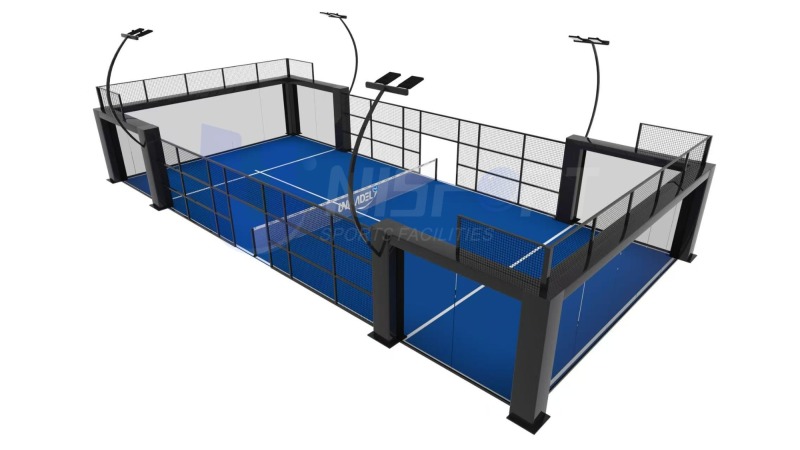
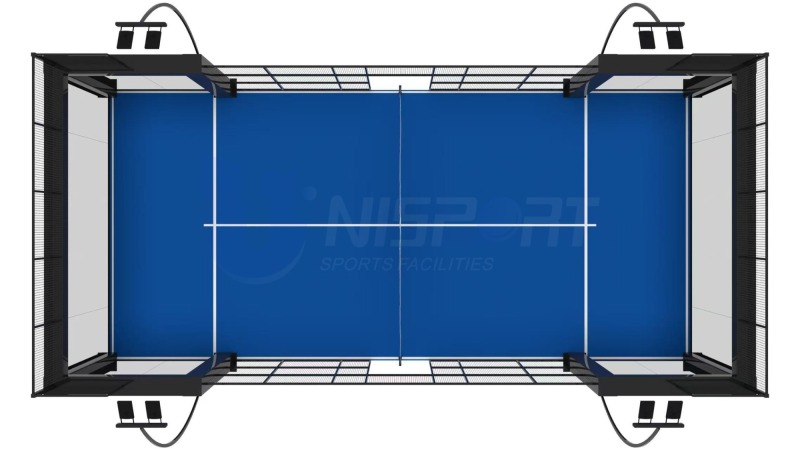
FORCE HX is UNISPORT’s hurricane-resistant padel court. It keeps the official 20 × 10 m standard padel playing size and layout. Every structural part is redesigned to withstand extreme wind gusts.
We upgraded the whole steel framework. The main posts use thick 200 × 200 × 6 mm square steel. The safety net is made of 50 × 50 × 4 mm welded steel, fixed on heavy-duty frames instead of thin lightweight panels.
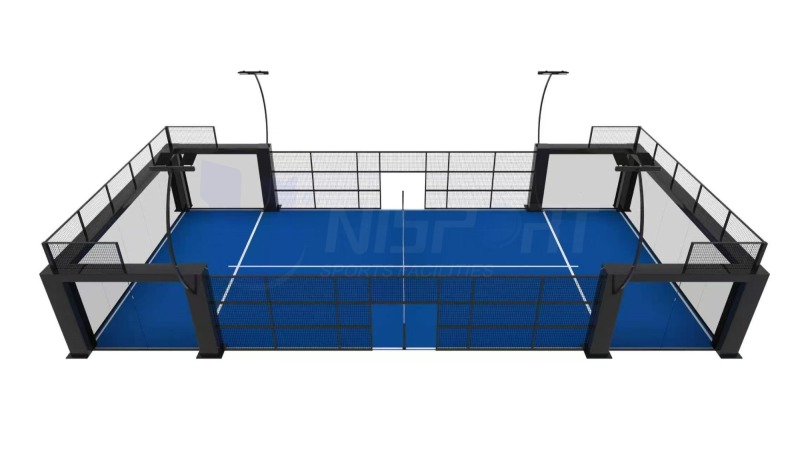
Four main posts are connected at the top, making the whole court one solid unit, not four separate supports. Strong wind force transfers through the top beams and columns down to the concrete foundation, protecting the glass panels from high pressure damage.
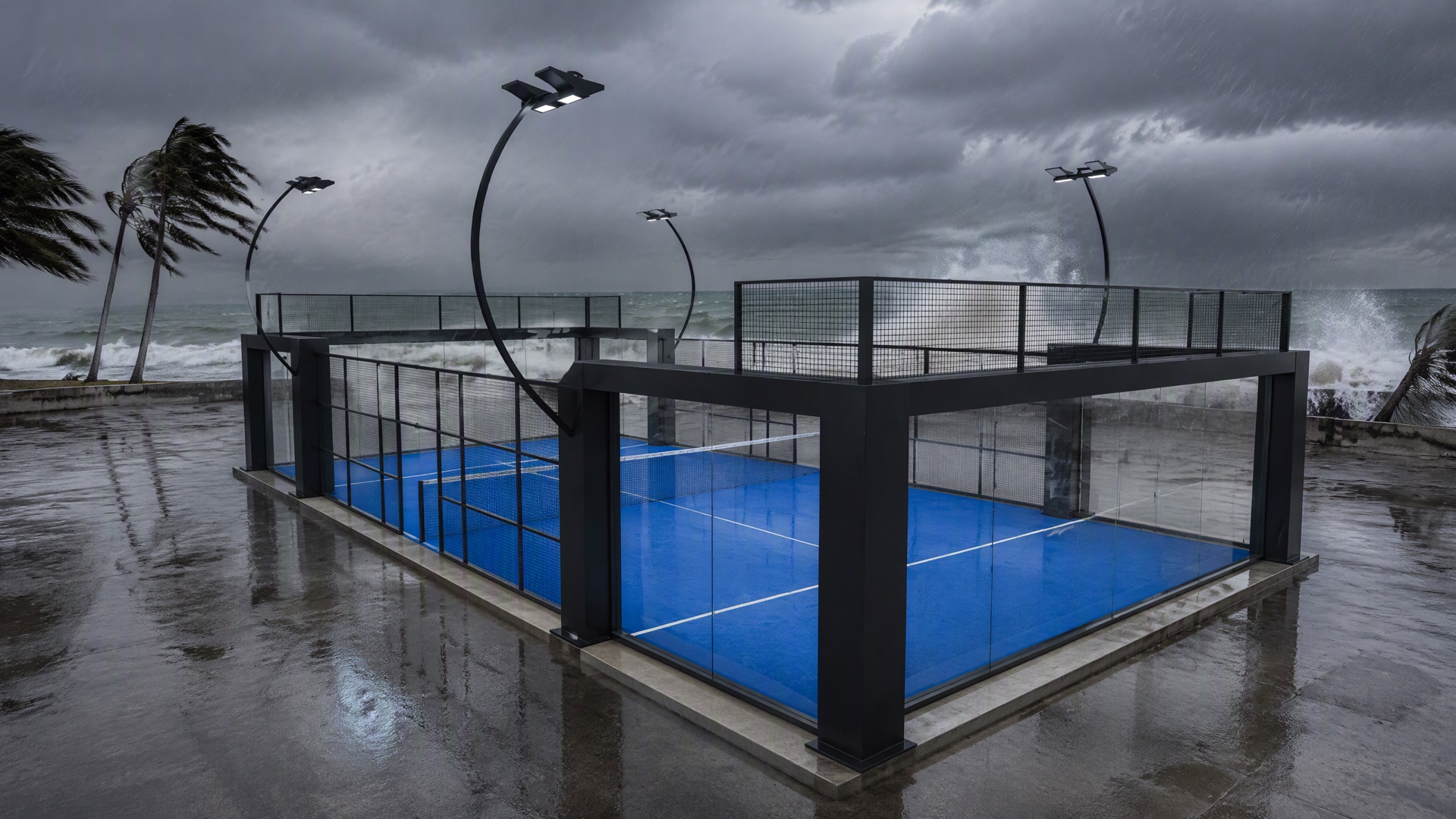
This court meets Category 4 hurricane standard, resisting gusts up to 220 km/h. Steel is hot-dip galvanised inside and out. Marine-grade bolts are optional for coastal salt-air environments.
It weighs more and costs more than regular padel courts. But for fully exposed sites, it saves you much more money over the whole service life of your venue.
Why Prefer the HX Padel Court
01 — A 220 km/h design gust, confirmed by structural analysis
The HX padel court is engineered against a design wind speed of 220 km/h (136.8 mph) and verified through structural mechanics analysis rather than desk estimation. That figure corresponds to the Category 4 hurricane benchmark — the line that separates a court you inspect after a storm from a court you rebuild after one.
02 — Four uprights behaving as one frame
A continuous overhead tie beam locks the uprights into a single rigid assembly. Lateral load landing across the windward mesh is shared between all four columns instead of concentrating at one corner, so the frame returns to true when the gust passes rather than staying permanently racked.
03 — Glass protected by controlling movement
Tempered panels seldom fail from pressure alone; they fail when the frame around them moves. Minimising frame deflection keeps every 12 mm panel in the plane its clamps were designed for, which is the entire point of paying for a storm specification.
04 — Corrosion protection you cannot see from outside
Every hollow section is hot-dip galvanised on the inside before the anti-UV polyester powder topcoat goes on, because the interior of a coastal steel tube is where rust takes hold first. Bolts and glass clamps are 304 stainless as standard, with marine-grade 316 available for splash zones and wash-down areas.
05 — Complete documentation for fast approval
Projects built in storm-prone areas usually need approvals from building authorities, insurance companies, or both. We supply section data, base plate & anchor layouts, plus foundation drawings. Your local structural engineer can review, validate and stamp these documents directly. This lets you submit a full package at the start, avoiding repeated queries during the approval process.
FORCE HX Padel Court — Key Specifications
• Court Type: Outdoor, storm-zone rated
• Playing Area: 20 × 10 m, FIP standard competition geometry
• Main Upright: 200 × 200 × 6 mm square steel tube
• Design Wind Speed: 220 km/h (136.8 mph), Category 4 hurricane standard
• Containment Mesh: 50 × 50 × 4 mm welded steel mesh with heavy-duty frames
• Glazing (Standard): 12 mm thermally toughened safety glass, EN 12150-2
• Corrosion Protection: Hot-dip galvanising (internal + external) + anti-UV polyester powder topcoat
• Fasteners: 304 stainless steel as standard; 316 marine grade optional
• Frame Colours: Black, white, blue, green, orange, violet; custom colour available
• Turf Colours: Blue, green, red, violet, black, pink
• Foundation: Reinforced concrete slab/beams C25/C30, minimum 150–200 mm
Five project types suitable for HX Hurricane-Class padel court
Coastal resorts and beach clubs
Large hotel grounds and beach clubs in the Caribbean and along the Gulf of Mexico, where the court anchors the guest offer and a storm closure is measured in lost revenue rather than damaged steel.
Rooftops and elevated podiums
City venues on building roofs or podium decks where wind shear at height, not available footprint, sets the structural requirement. The continuous tie beam design is what makes a tall exposed deck viable.
Cliff and headland sites
Clubs on seaward slopes with an unobstructed wind fetch — including island resorts across Southeast Asia and Okinawa. Exposure here is constant rather than seasonal, and salt is present every day of the year.
Municipal and school facilities inside the Western Pacific typhoon corridor
Public courts along the southeastern coast of China and its island provinces, where the requirement is not prestige but serviceability: the court has to reopen in the same week as everything else in the district.
BASE WORKS AND WATER MANAGEMENT
The HX padel court carries a heavy dead load and produces high base shear at design wind speed. The base is part of the structure, not a detail at the end of the project.
Base slab
· Footprint ≥ 21 × 11 m for a single court, finished flat to ± 2 cm.
· Build-up, top to bottom: 150 mm C25 concrete → 150 mm 6% cement-stabilised stone powder → 200 mm compacted crushed stone → excavated and compacted subgrade.
· Cure 28 days before the structure is positioned.
· Verify before installation: flatness across the full slab with a 13 m straightedge, surface hardness, and residual moisture ≤ 8%.
Anchoring
· Side uprights on 230 × 200 mm base plates; corner uprights on 250 × 250 mm base plates.
· Connector plates and expansion anchors as standard; chemical anchors where the court is anchored into existing concrete.
Water
· Perimeter ditch 25–30 cm wide, 35 cm deep, brick or concrete lined and covered, laid to a 0.5% fall and connected to the site drainage network.
· Court surface crowned — high at the centre, falling to the edges — at 3–10%, with longitudinal fall held to 1‰ or less so the playing surface drains without running.
Storm-zone note: anchor design and base thickness should be confirmed against your local wind code by the engineer stamping the project. We supply the corresponding load and anchor drawings as part of the package.
FAQ
1. Will it work on an existing concrete slab, or do we need new foundations?
It depends on what is under the slab. The HX padel court transmits high base shear at design wind speed, so an existing slab has to be assessed for thickness, reinforcement and compressive strength before it can be signed off. Where a slab passes, we anchor with chemical anchors instead of cast-in expansion anchors. Where it does not, we specify a reinforced beam or slab overlay at 150–200 mm in C25/C30.
2. What is the difference between FORCE HX and FORCE HS?
Steel section and rating. The HS uses a 100 × 100 × 4.75 mm upright and is rated to 165 km/h on a Category 2 standard. The HX uses 200 × 200 × 6 mm uprights and reaches 220 km/h on a Category 4 standard. Mesh, glazing and finish systems are shared, so the choice comes down to the design wind speed in your local code.
3. Does the court arrive complete, and how much assembly happens on site?
It ships as a knocked-down kit: pre-drilled columns and tie beams, mesh panels in their frames, glass, clamps, base plates and fasteners. Site work is assembly and alignment over a prepared base rather than fabrication — nothing is cut, welded or painted on site.
4. How does the coating hold up to salt air, and what maintenance does it need?
Hot-dip galvanising protects both the inside and the outside of every hollow section, with an anti-UV polyester powder topcoat over it for salt spray, acid rain and strong sunlight. In practice, maintenance is an annual visual inspection of the coating and the fasteners, with touch-up on any scratch or impact mark before corrosion can start.
5. If a panel or a glass unit is damaged in a storm, can it be replaced on its own?
Yes. The system is modular. Individual mesh panels and glass units, together with their clamps and seals, can be supplied and installed separately, so a localised failure does not require replacing the frame.