Pickleball Courts: Setting the Stage for Exciting Play
Pickleball is a fast-paced, increasingly popular sport that has taken the leisure scene by storm with its unique blend of tennis, badminton, and table tennis elements. At the heart of this engaging sport is the pickleball court, a carefully designed playing surface that sets the stage for exciting play and friendly competition.
Standard Pickleball Court Dimensions
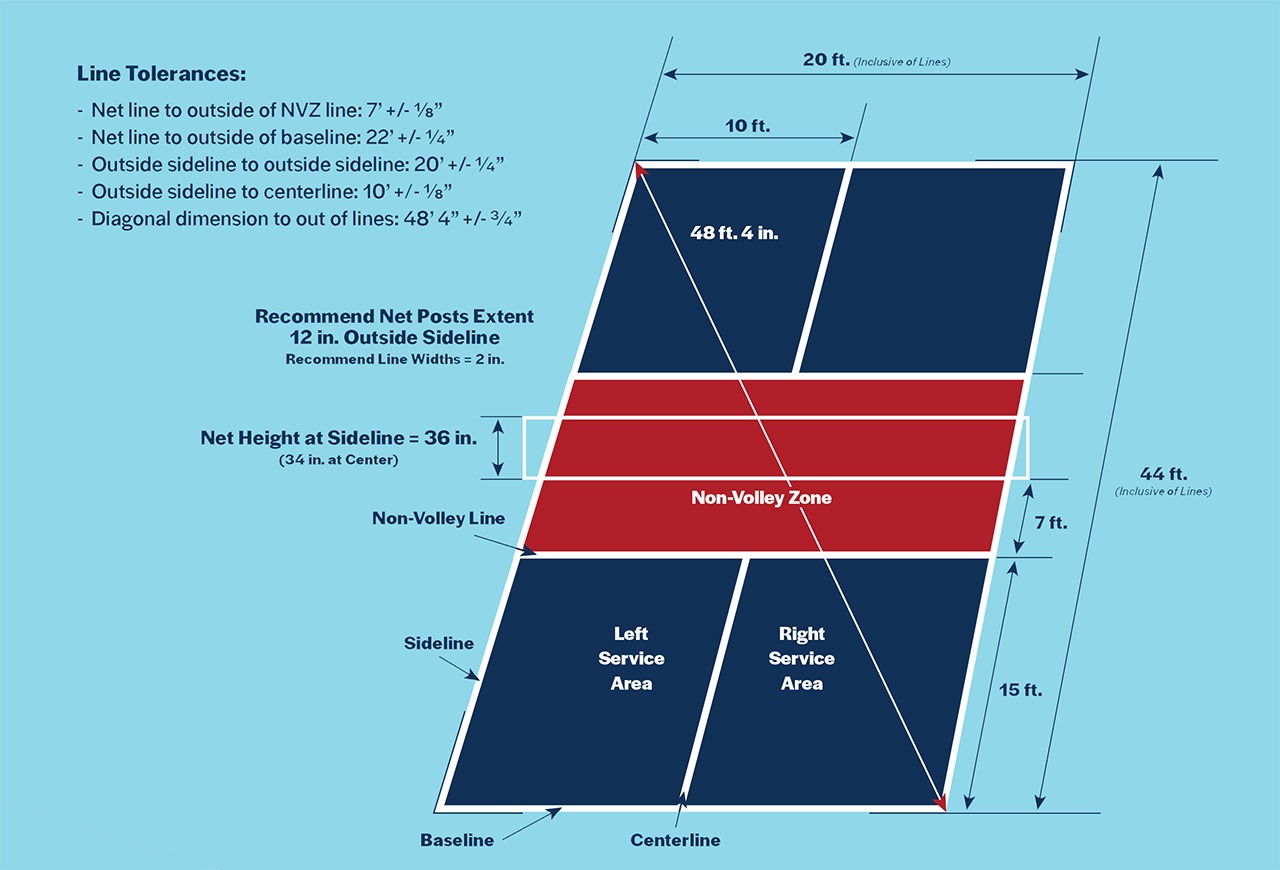
A standard Peak court is 44 feet long and 20 feet wide, providing ample space for strategic rallies and quick reactions. The net posts are 36 inches wide at the sides and 34 inches wide in the center. A total footprint of at least 34 feet wide x 64 feet long, including the buffer zone, is recommended.
Pickleball Court Key Area Divisions
1. Non-Volley Zone (NVZ, commonly known as the Kitchen Zone)
Location: A 7-foot-wide strip on each side of the net, extending 20 feet across the entire court.
Rules: Volleying is strictly prohibited when a player's foot is on/in contact with this area; the ball must bounce once before being hit; stepping into the area after hitting the ball is also a violation.
Line Width: 2 inches; the lines themselves are within the NVZ.
2. Service Courts
Division: Enclosed by the center line, sidelines, baselines, and NVZ lines, each side is divided into two 10-foot x 15-foot rectangles by the center line; the right side is the even-numbered service court, and the left side is the odd-numbered service court (positions are determined by odd/even scores).
Serving Requirements: The serve must be diagonally from behind the baseline to the opponent's corresponding service court; the serve cannot land directly in the NVZ.
3. Centerline
Direction: Extends vertically from the back of the NVZ line to the baseline, without crossing inside the NVZ.
Function: Strictly divides the left and right service courts. The server must stand on the corresponding half when serving, and the ball must land on the opposite half.
4. Baseline and Sideline
Baseline: The backcourt line parallel to the net. The server must stand behind the baseline (stepping on the line is allowed, but crossing it is not).
Sideline: The longitudinal sidelines on either side of the court, defining the left and right valid areas for the ball; a shot going out of bounds or onto the baseline results in a point loss.
5. Net Area
Net Height: 36 inches at the sidelines, dropping to 34 inches in the middle; the net length must cover the entire width of the court, and the mesh must not allow the ball to pass through.
6. Safety Buffer Zone
It is recommended to leave the following buffer zone outside the playing area: ≥3m behind the baseline and ≥1.5m outside the sidelines; official matches are usually planned with a total court size of 34 feet × 64 feet to avoid players running into the boundaries.
Surface Materials and Selection Guide
1. Acrylic Coating System
Features and Benefits:
• All-acrylic coating system provides excellent weather resistance and UV protection.
• Customizable surface texture, balancing ball speed and slip resistance.
• Vibrant and long-lasting colors, relatively low maintenance costs.
• Standard choice for professional competitions.Suitable for: Professional competition venues, schools, outdoor clubs, community parks
2. Silicone Polyurethane (PU) Resilient System
Features and Benefits:
• Unique three-layer structure (resilient layer, reinforcing layer, surface layer) provides excellent shock absorption.
• Effectively reduces sports fatigue and joint injuries, especially suitable for prolonged activities.
• Excellent weather resistance and environmental performance.
• Seamless surface, aesthetically pleasing and easy to clean.
Suitable for: Multi-purpose sports stadiums, youth activity centers, senior-friendly communities, training bases
3. Indoor Suspended Sports Flooring
Features and Benefits:
• Modular design, quick installation, no adhesive required.
• Excellent vertical deformation and shock absorption (compliant with DIN standards).
• Removable and movable, suitable for multi-functional venues.
• The suspended space underneath facilitates shock absorption and air circulation.
Suitable for: Indoor stadiums, fitness centers, school multi-purpose halls, rental venues
4. Artificial Turf
Features and Advantages:
• Filled with quartz sand and rubber granules, providing a unique and comfortable feel underfoot.
• Extremely low maintenance requirements and rapid drainage.
• Aesthetically pleasing, suitable for locations with high landscape integration.
Suitable for: Resorts, high-end residential areas, leisure clubs
Professional Construction Process
1. Site Assessment and Preparation
• Soil testing and compaction (achieving over 95% compaction)
• Drainage system design and pre-installation (preventing water accumulation after rain)
• Concrete or asphalt base course construction (flatness error must be controlled within 3mm/3m)
2. Elastic Layer Laying
• Construction according to material characteristics, ensuring uniform thickness
• Key control points: Environmental performance testing, elasticity testing
3. Surface Layer Construction
• Acrylic system: Multi-layer spraying, with strict control over the interval between each layer
• Silicon PU system: Scraping application, ensuring thickness and flatness
4. Line Marking and Marking
• Use professional sports marking paint, 5cm wide
• Color must provide a clear contrast with the surface layer (usually white or blue)
5. Installation of Supporting Facilities
• Professional-grade net posts and nets (center height adjuster recommended)
• Fencing system (usually 4 meters high, anti-glare treatment)
• Lighting system (average illuminance 200-300 lux, uniformity meets standards)
Why are pickles so popular?
Flexibility to adapt to a variety of environments
The adaptability of pickleball courts to a variety of environments further enhances the accessibility of the sport. While standard dimensions are followed in official tournaments and competitions, the flexibility of play allows for the creation of makeshift courts in driveways, backyards, and community centers. Portable nets and court boundary lines allow enthusiasts to enjoy pickleball almost anywhere, fostering a sense of community and camaraderie.
A Versatile Playground for Everyone
One of the defining features of pickleball is its versatility, which caters to players of all ages and skill levels, ensuring a standardized playing surface that enhances the overall experience for beginners and experienced players alike.
Standardized dimensions enhance the playing experience
The dimensions of a pickleball court play a key role in shaping the nature of the game. Carefully measured widths, lengths, and specialized areas contribute to the strategic and dynamic nature of pickleball, making it an appealing sport for players of all backgrounds. Whether playing in a competitive setting or enjoying a friendly game on a makeshift court, standardized dimensions ensure a consistent and enjoyable pickleball experience for all.
 Top 6 Characteristics and Application Scenarios of EPDM Rubber Granules
 Professional Running Track Construction Guide
 What Attracts Investors Most About Building Padel Courts
 How to Install Artificial Turf for Padel Courts