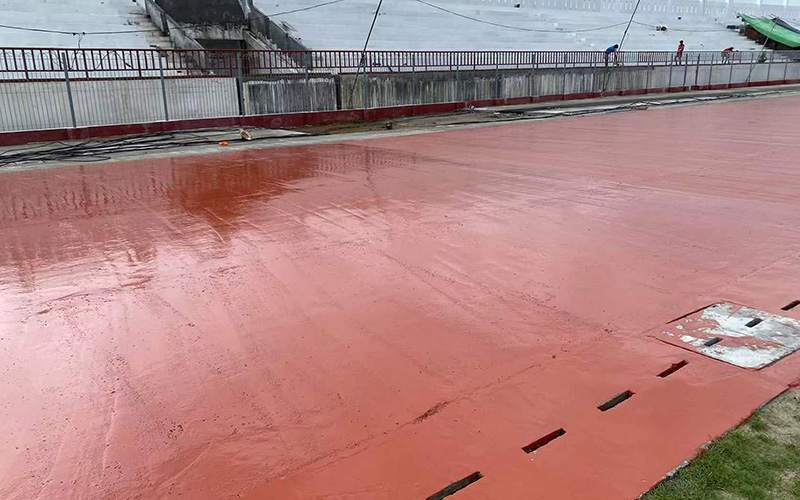
The characteristics and installation process of acrylic sports floor
We use cookies to improve your online experience. By continuing browsing this website, we assume you agree our use of cookies.

The characteristics and installation process of acrylic sports floor

Views : 539
Update time : 2023-05-04 14:24:19
As we all know, acrylic, like pp tiles, has always been one of the very popular floors for outdoor basketball courts, badminton courts, and tennis courts. The overall cycle is not too long, and it is a project that many customers really want to bid for. The basic construction time is about 7-20 days

First of all, we need to know about acrylic stadium floor materials. Its overall coating system conforms to the principle of very environmental protection, especially some toxic substances such as lead and mercury on the market. Our factory produces products that are absolutely in line with international hygiene and health. Generally, the acrylic material layer of our paint is about 1.5-2mm, and it is generally applied on asphalt, concrete, cement and other foundations. Even in the sun and rain outdoors, it will not oxidize and wear to a large extent, and its waterproof and non-slip properties have always been the materials favored by investors.

The installation of acrylic sports flooring requires the following steps:

1. For the cleaning of the stadium foundation, if it is an asphalt ground, it needs to be leveled as a whole, loosen it with tools, and then rinse off the oil layer on the surface; The poorly treated mud is broken up, and then rinsed with clean water.

2. Then start to paint. Before starting, it is necessary to mix the acrylic paint and water in proportion, and use a tool roller to paint and paint, so that our paint can be fully mixed on the overall concrete floor. After a long time, it is not easy to make the ground bulge.

3. After the materials are fully mixed and stirred, the mixed pigments are evenly and neatly applied to the acrylic primer, thus forming a strengthened bottom layer. The process of reapplying should not be too fast or too slow, the whole should be covered evenly, and the next step can only be carried out after 2-4 hours of drying.

4. The next step is the wear layer and the color layer. In this way, the two layers are to protect the floor material and increase the friction of the surface. When applying it, it is applied evenly as in the above steps, so that the color can be averaged and the effect is guaranteed. Only in this way can it be stable and not easily deformed and cracked by external interference.

5. The last step is to scribe and clean the test. The effect of marking lines in different venues is also different. The texture of the entire line needs to match the site and be tightly combined with the acrylic. The waiting time for the white line is about 4 hours, and you can try it when it is stable.
Related News
Read More >>
Things to pay attention to when building a roofed padel court Things to pay attention to when building a roofed padel court
Apr .25.2026
When building a covered padel tennis court, consider structural design, material selection, lighting, ventilation, etc. Ensure the quality and functionality of the court, enhance the players' sports experience, and bring higher commercial returns to investors.
Learn More About Different Types of Padel Courts Learn More About Different Types of Padel Courts
Apr .24.2026
Different types of padel tennis courts range from indoor and outdoor court to panoramic and tournament-level, each padel court with its own characteristics and advantages.
A guide to the composition and characteristics of padel A guide to the composition and characteristics of padel
Apr .23.2026
Explore key padel court features including FIP dimensions, materials, safety and maintenance tips. Learn what makes a professional padel court durable and player friendly.
Padel Court Construction Guide 2026 Padel Court Construction Guide 2026
Apr .16.2026
Complete 2026 guide to building a FIP-standard padel court: official dimensions, materials, artificial turf, lighting requirements, construction steps and costs.