Building a new running track is a complex and precise project involving multiple steps and key factors. Generally speaking, it usually takes 10 to 14 weeks from start to completion. The fluctuation of this time frame mainly depends on the location of the site, the slope of the terrain, weather conditions, and the impact of existing infrastructure. Below, we will analyze the key factors that affect the construction time of the running track from different perspectives.
Factors Affecting Runway Construction Period
The core reason for fluctuations in construction period lies in the differences in project foundation conditions. The following are the most significant factors that need to be considered during planning:
1. Runway Type and Material Selection
Different materials used in runway construction have varying degrees of complexity and significantly different construction times. Precast rubber roll runways are the fastest to construct, requiring only splicing, bonding, and compaction on-site, saving 2-3 days compared to cast-in-place mixed or permeable runways. All-plastic runways, due to their high material mixing requirements and long curing time, take the longest, adding 1-2 weeks compared to ordinary mixed runways.
2. Site Foundation Conditions
The construction period for renovation projects differs significantly from that of new construction projects: Renovating an old runway only requires removing the existing surface layer (1-2 days) and then laying the new layer, shortening the overall on-site construction period by 2-3 weeks. New construction projects require starting from earthwork excavation and foundation compaction. If the site has problems such as water accumulation or soft soil, additional treatment is needed, which will increase the construction period accordingly.
3. Weather and Environmental Factors
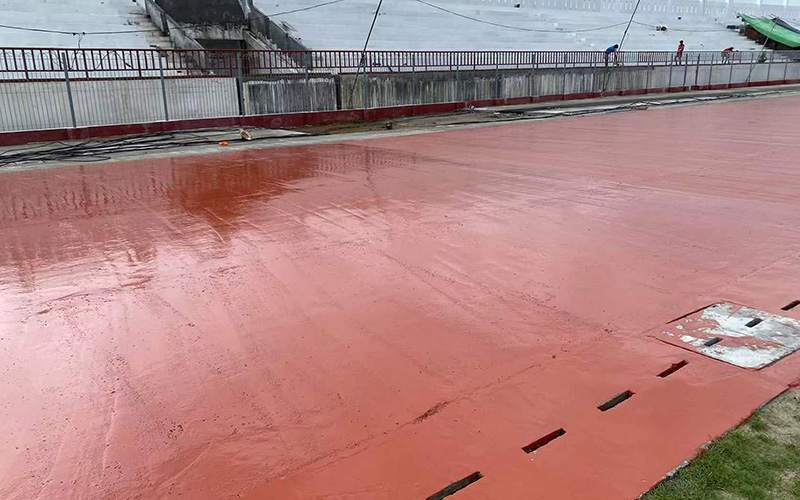
The construction of synthetic material running tracks is subject to strict requirements regarding temperature and humidity. The optimal construction temperature is 15-30℃. Temperatures below 10℃ will cause slow adhesive curing, while temperatures above 35℃ can easily lead to material cracking. Work must be completely suspended during rainy or foggy days. If continuous rain occurs during construction, the project may be delayed by 1-2 weeks. Furthermore, outdoor sites should avoid strong winds to prevent damage to the surface coating.
4. Project Scale and Additional Requirements
The on-site construction time for a standard 400-meter athletic track (including field events area) differs from that of a 200-meter school sprint track by 1-2 weeks. If additional construction of a long jump sandpit, high jump mat area, drainage system upgrades, or compliance with IAAF certification standards is required, additional testing and process refinement steps will be necessary, adding 3-5 days to the construction period.
Impact of site selection on construction time
Site selection is one of the key factors that determine the construction time. Different geographical environments have an important impact on the construction progress, such as:
Soil conditions: Soft soil, swampy land or rock foundations require additional treatment such as drainage, reinforcement or blasting, which will extend the construction time.
Environmental protection requirements: Some areas may require environmental assessments to ensure that the ecosystem will not be damaged, which may increase the preparatory time.
Climate conditions: Severe weather such as heavy rain, heavy snow or extreme heat may cause construction to be suspended, affecting the overall progress.
If the site is located in an area with flat terrain and stable climate, the construction time is usually shorter; on the contrary, if the site conditions are more complex, it may take longer to complete the construction.
Terrain slope and construction difficulty
The slope of the terrain directly affects the difficulty and time required for construction. running tracks usually need to be as flat as possible to ensure safety and stability. If the terrain is steeper, the following additional steps are required:
Cut and fill: Uneven areas need to be filled or excavated to ensure the levelness of the running track.
Drainage system construction: Areas with steep slopes require additional drainage facilities to prevent water accumulation from affecting the quality of the running track.
Foundation reinforcement: Some terrains may require additional foundation stabilization measures, such as piling or the use of reinforcement materials.
For terrains with steep slopes, construction time may increase by 2 to 4 weeks compared to flat terrain, depending on the amount of work required.
Construction process and time schedule
The construction process is usually carried out in the following stages, and the construction period of each stage needs to be accurately calculated:
1. Preliminary Preparations and Site Clearance (1-2 weeks)
For renovation projects, this stage mainly involves removing the surface layer of the old runway and clearing away debris (1-2 days). For new construction projects, site surveying, design briefing, earthwork excavation, and site leveling are required (3-5 days), along with erecting construction fencing and installing water and electricity facilities (1-2 days). If approval procedures are involved (such as environmental impact assessments for municipal projects or registration for campus projects), these procedures need to be initiated 1-2 months in advance and are not included in the on-site construction period.
2. Foundation and Drainage System Construction (1-2 weeks)
The foundation is crucial to the lifespan of the runway and requires strict control over the construction period and quality. First, lay a layer of graded crushed stone, compact it until it reaches the required flatness, and then install drainage pipes to ensure rapid rainwater drainage and prevent bulging and cracking later. If the soil bearing capacity is insufficient, an additional geotextile or cement stabilization layer needs to be laid, adding 3-4 days to the construction period.
3. Asphalt base laying (3-5 days)
After the foundation passes inspection, the asphalt concrete surface layer is laid, in two layers (coarse-grained base layer and fine-grained surface layer). Each layer is compacted promptly after laying to ensure that the surface flatness error does not exceed 3mm/3m. The surface must be allowed to cool naturally for at least 24 hours before proceeding to the next stage.
4. Buffer Layer and Topcoat Application (6-10 days)
First, lay the black rubber granule buffer layer (EPDM/SBR material). Use a mechanical mixer to mix the adhesive and granules, spread evenly, and then compact. After the buffer layer has cured, spray the colored topcoat, applying two coats to ensure uniform thickness. The topcoat needs to be left to cure for 48 hours after application to avoid surface damage.
5.Line Marking and Installation (2-3 days)
Following international athletics standards, professional positioning equipment is used to mark the track lines, lane lines, finish line, and field event area markings. Wear-resistant line paint is applied to ensure clear, firm, and unwavering lines. After marking, allow the lines to stand for 24 hours to prevent rain or foot traffic.
6. Testing and Curing (7-14 days)
After installation, flatness, slip resistance, and elasticity coefficient tests are conducted. Once these tests are passed, the material enters the full curing period. It is recommended to allow for light use after 7 days of curing and to wait 14 days before engaging in high-intensity athletic activities to ensure the material's lifespan is protected from incomplete curing.
Impact of existing infrastructure
If there are already buildings, pipelines, cables or other infrastructure in the running track construction area, it may affect the construction time. For example:
Buildings need to be demolished or relocated, which increases the preparatory time.
Replanning of underground pipelines requires additional engineering design and approval.
Adjustments to power and communication lines may require coordination with multiple departments, extending the construction period.
If the existing infrastructure is complex, the running track construction time may be extended by an additional 2 to 6 weeks.
Other factors affecting the construction progress
In addition to the main factors mentioned above, the following situations may also affect the construction time:
Material supply: Delays in the procurement and transportation of construction materials will affect the overall progress.
Construction staff arrangement: The experience and efficiency of the construction team directly affect the speed of construction.
Government approval process: If additional permits or regulatory approvals are required, the project progress may be delayed.
How to effectively control the construction period?
Early Planning, Early Start: Prioritize design and bidding processes to avoid peak construction seasons (such as summer vacation) and strive to start construction during ideal weather windows.
Choose an Integrated Service Provider: Prioritize professional sports flooring companies that can provide comprehensive services from design and foundation to surface layer and marking. This avoids communication costs and blame-shifting associated with multi-party collaboration, significantly improving efficiency.
Prioritize the Foundation: Any reduction in foundation curing time can lead to fatal problems such as surface layer cracking and bulging in the future, resulting in greater time and financial losses.
Allow Buffer Time: When developing the overall project plan, it is recommended to allow 10-15% buffer time for the entire construction period to cope with unforeseen weather and other emergencies.
Clear Communication and Decision-Making: Maintain smooth communication with the construction team and promptly confirm plans and material selections. Your decision-making speed directly impacts the project workflow.
FAQ
1. How long will rain delay the construction period?
Light rain may cause a 1-2 day work stoppage to allow the site to dry; continuous rain or heavy rain may disrupt the entire construction sequence, potentially causing delays of several weeks. Professional construction teams monitor weather forecasts daily and adjust work procedures accordingly.
2. How long after completion can the running track be put into use?
It can be used after the surface layer is fully cured and passes final acceptance. Typically, it reaches usable strength 5-7 days after the surface layer is completed.
3. Our school only has a 2-month summer vacation, can it be completed?
Absolutely. For standard school running track projects, with a professional team and proper preparation, a 40-50 day construction period is common and reliable. The key is to start preliminary work immediately, ensuring the construction team can enter the site on the first day of summer vacation.
4. Can construction be carried out in winter?
Generally not recommended. Low temperatures severely affect the curing reaction of plastic materials, leading to decreased performance or even failure to cure. If construction must be carried out in winter, special low-temperature materials or expensive constant temperature protection measures must be used.
 Top 6 Characteristics and Application Scenarios of EPDM Rubber Granules
 Professional Running Track Construction Guide
 What Attracts Investors Most About Building Padel Courts
 How to Install Artificial Turf for Padel Courts